Mozilla Introduces Thunderbolt: An Enterprise AI Client Built for Control and Independence
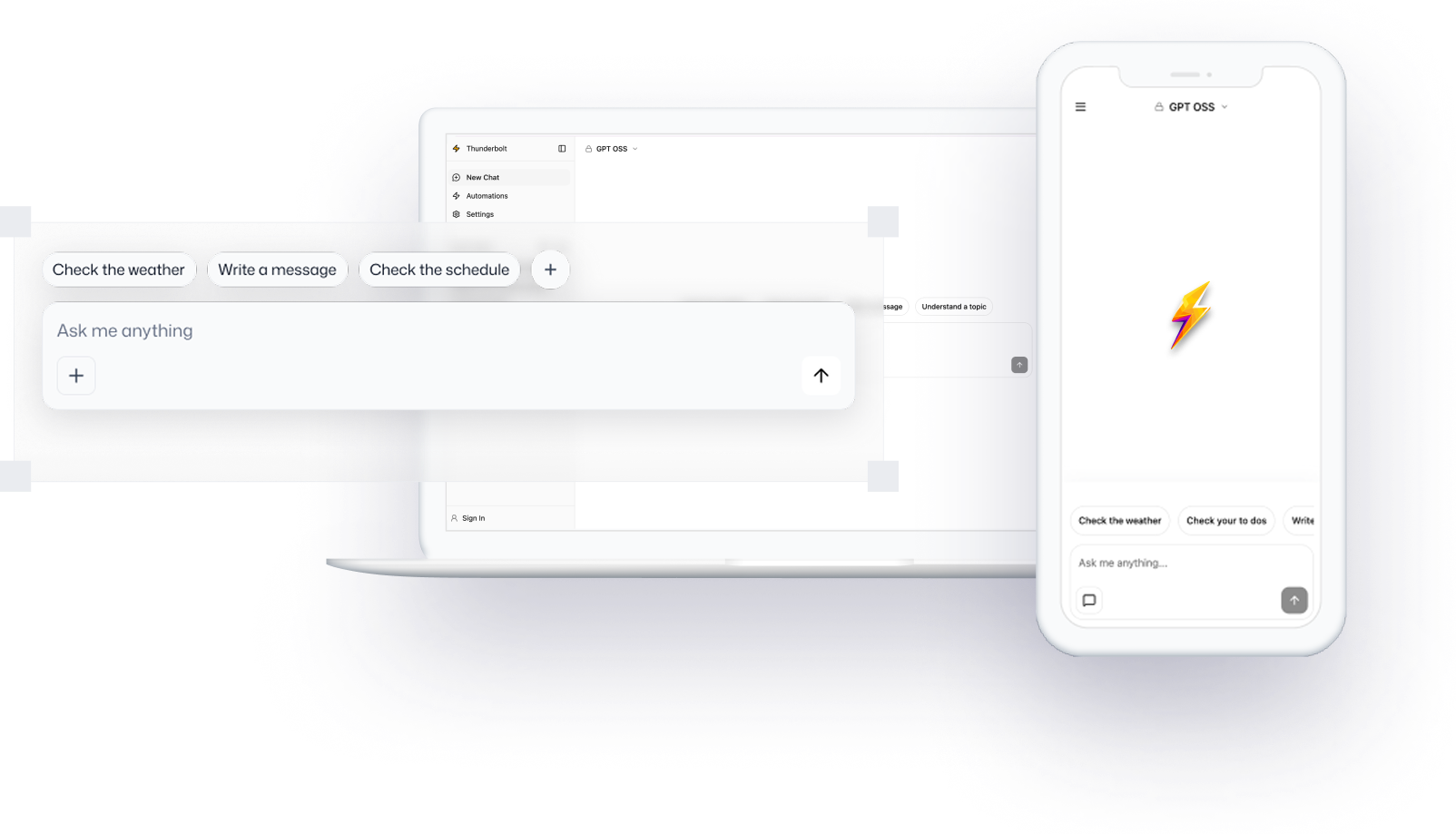
MZLA Technologies Corporation, a subsidiary of the Mozilla Foundation, today announced Thunderbolt, an open-source AI client that gives organizations what proprietary AI services can’t: full ownership of their data, freedom from vendor dependencies, and AI infrastructure that stays entirely within their hands — self-hostable, customizable, and built on open standards.
Organizations need solutions that provide flexibility and capability without sacrificing control, transparency, or long-term independence. Through a native integration with deepset’s Haystack, Thunderbolt extends control to the infrastructure layer — connecting the client experience with enterprise-grade agents and RAG orchestration within a unified architecture.
“AI is too important to outsource. With Thunderbolt, we’re giving organizations a sovereign AI client that allows them to decide how AI fits into their workflows — on their infrastructure, with their data, and on their terms.”
Ryan Sipes, CEO of MZLA Technologies Corporation
An open, extensible AI workspace
Thunderbolt is designed as a sovereign AI client — an open-source, extensible workspace where users can interact with AI through chat, search, and research, connect to enterprise data, and choose the models and tools that fit their needs.
It allows organizations to:
- Run AI with their choice of models, from leading commercial providers to open-source and local models
- Connect to systems and data: Integrate with pipelines and open protocols, including deepset’s Haystack platform, Model Context Protocol (MCP) servers, and agents with the Agent Client Protocol (ACP)
- Automate workflows and recurring tasks: Generate daily briefings, monitor topics, compile reports, or trigger actions based on events and schedules
- Work seamlessly across devices with native applications for Windows, macOS, Linux, iOS, and Android
- Maintain security with self-hosted deployment, optional end-to-end encryption, and device-level access controls
By combining flexibility, extensibility, and control, Thunderbolt transforms AI from a standalone tool into a customizable system that adapts to each organization’s specific needs and workflows.
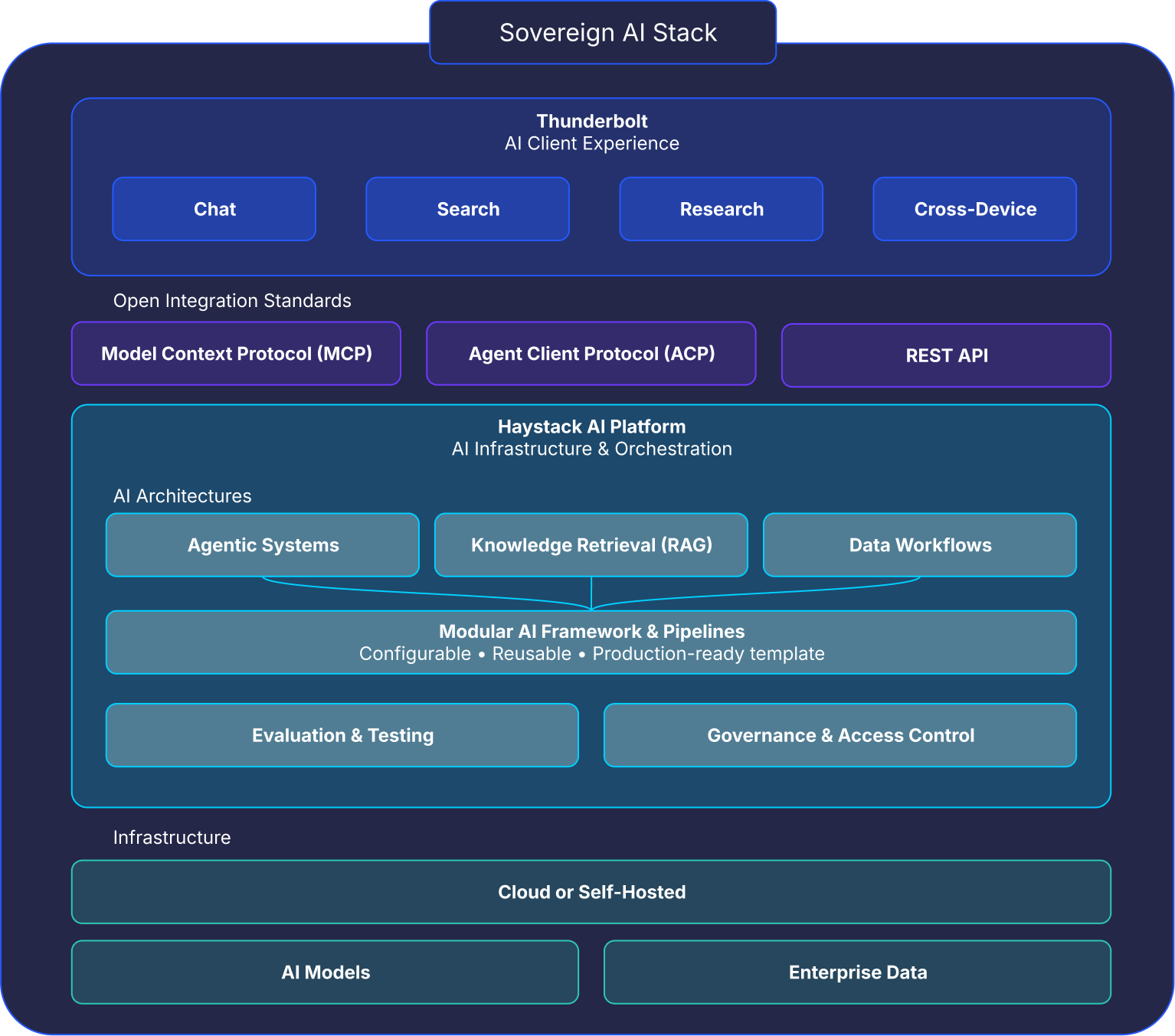
From infrastructure to interface: a complete sovereign AI stack with deepset’s Haystack
Organizations increasingly recognize that sovereignty can’t stop at the interface. It must extend across the entire stack, from how systems are built and governed to how they are used every day.
To support this, MZLA Technologies Corporation is partnering with deepset, a Berlin-based AI infrastructure company behind the popular open-source Haystack agent framework. Together, Thunderbolt and Haystack connect the user-facing AI experience with agent and RAG backend orchestration, enabling organizations to operate AI systems within a unified architecture.
deepset works with enterprise and public sector organizations — including government agencies, aerospace manufacturers, and multinational organizations — embedding forward-deployed engineering teams directly within client environments to support architecture, implementation, and ongoing operations.
Together, the platforms connect two critical layers — how AI is experienced and how it is built:
- AI Client Experience (Thunderbolt): A sovereign AI client that enables chat, search, research, automation, and cross-device workflows through a self-hostable, extensible interface
- AI Infrastructure & Orchestration (deepset / Haystack): The foundation where AI systems are built, deployed, and governed — enabling agents, RAG applications, and data-driven systems across cloud or fully self-hosted environments
This integrated approach moves organizations beyond fragmented AI tools toward operational AI systems, where the user experience and underlying infrastructure are tightly connected and AI becomes a governed, reliable part of daily operations rather than isolated capabilities.
“Integrating with Haystack is a natural opportunity to extend Thunderbolt’s sovereignty to the infrastructure beneath. This gives organizations control not just over how they interact with AI, but how it is built and run.”
Ryan Sipes, CEO of MZLA Technologies Corporation
“Organizations are looking for a complete sovereign AI stack, paired with the expertise to deliver it. Together, Haystack and Thunderbolt bring both — enabling teams to move from concept to production with full control.”
Milos Rusic, CEO and co-founder of deepset
Availability
Thunderbolt is available now via waitlist at thunderbolt.io with native applications for web, macOS, Windows, Linux, iOS, and Android. The Thunderbolt source code is available on GitHub.
For enterprise deployments, Thunderbolt pricing reflects support level, customization requirements, and deployment complexity. Integration partners can package Thunderbolt with sovereign storage, infrastructure management, and Forward-Deployed Engineering support as part of comprehensive sovereign AI solutions.
Organizations interested in pilot deployments or enterprise licensing should contact [email protected].
About MZLA Technologies Corporation
MZLA Technologies Corporation is a wholly owned subsidiary of the Mozilla Foundation and the organization behind Thunderbird, one of the world’s most widely used open-source email clients with over 20 million active users. Guided by principles of openness, user control, and privacy, MZLA develops software that gives individuals and organizations ownership over their digital infrastructure. Thunderbolt is funded through a dedicated investment from Mozilla and is being developed by a separate team focused on enterprise AI products, distinct from Thunderbird’s donation-supported consumer product work.
About Mozilla
Mozilla is a non-profit organization whose mission is to ensure the internet is a global public resource, open and accessible to all. Mozilla creates and maintains Firefox, one of the world’s leading web browsers, and invests in products and initiatives that advance openness, privacy, and individual empowerment online. Learn more at mozilla.org.